
 KOR
KOR ENG
ENG CHN
CHNPigmentation
Once melasma fades, does it never come back?
After several months of care, the patches faded, but after summer they seem to be coming back, and some people feel disappointed. You may even start to doubt whether the treatment was done wrongly or did not work.
Melasma is closer to a condition managed over the long term than one that ends with a single treatment. This article sets out why it can come back, what affects it, and what is good to keep up in daily life.
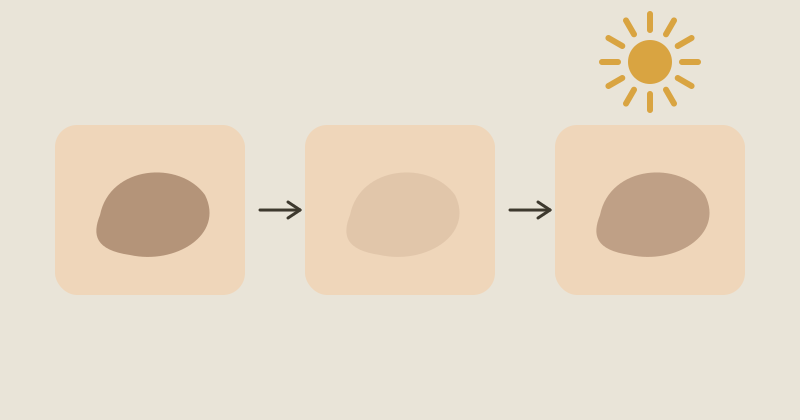
Why does melasma come back?
Melasma is known to arise not from a single cause but when several factors, such as ultraviolet light, heat, friction, and hormonal changes, overlap and pigment production becomes active. Even if the visible color fades, it can darken again if the conditions that produce pigment remain.
For this reason, the pattern of recurrence differs from person to person even after the same treatment, and changes in season or living environment can also have an influence in some cases.
What factors should I be careful about?
The factors that can be reduced in daily life can be summarized as below. The size of the effect differs from person to person.
| Factor | Why it may have an effect | What you can do in daily life |
|---|---|---|
| Ultraviolet light | Stimulates pigment production | Sunscreen and a hat; use sunscreen even when sitting by a window |
| Heat | May increase pigment activity | Reduce exposure to saunas and intense heat |
| Friction | Skin irritation may lead to pigmentation | Do not rub when washing or cleansing |
| Hormonal changes | May be related to pigment changes | Let the clinic know in advance at your visit if there are changes |
What should I do if it darkens again?
If you feel that it has darkened again, it is better to first have your current skin condition checked rather than trying strong products or procedures on your own. This is because the approach may differ depending on whether it is melasma or whether other pigment changes are mixed in.
Telling the clinic your care records (products used, timing of procedures, changes in living environment) helps in finding the cause and adjusting the plan.
However, if only one side becomes unusually dark, the shape is asymmetric or the borders become irregular, or if it quickly grows larger, itches, or bleeds, it may be a pigmented lesion other than melasma, so please have it checked at a consultation without delay.
Frequently asked questions
Q. How long after treatment can I feel at ease?
A. It is hard to say there is a set period. It is more accurate to see melasma as a condition that is managed continuously, so keeping up care habits matters more than a point at which to feel at ease.
Q. Can I skip sunscreen in winter?
A. Ultraviolet light is present in winter too, and it also comes indoors through windows. We recommend using sunscreen consistently according to how much you are exposed, rather than by season.
Q. Can using only melasma cosmetics prevent recurrence?
A. It is hard to say that one product can prevent recurrence. Basic habits such as sun protection and reducing irritation, together with regular check-ups of your skin condition, are needed.


